Britain has two answers to online misinformation. Neither of them covers health.
Andy Burnham announced a “National Centre for Information Defence” at the UN last month, built to detect, attribute and disrupt hostile state information attacks and deepfakes. The case for founding an organisation like this is undeniably strong, but the premise also assumes an adversary with a budget and a chain of command. Most health misinformation has neither. Britain's other answer, the Online Safety Act, lost the duties that would have covered it in 2022.
Burnham told the General Assembly that the Kremlin spends around £1.3 billion each year manipulating information, and that Britain and its allies have been subject to an industrial-scale assault. The centre will work alongside the intelligence agencies, government departments, the police and the social media companies, led initially by the Cabinet Office.
In 2021 a Russia-based marketing firm called Fazze approached European YouTubers with offers of money to tell their followers that Pfizer’s COVID-19 vaccine was dangerous. Two refused and went public, and Facebook, in a rare case of doing the right thing, removed the influencer network Fazze had built. We think health misinformation absolutely belongs in the new centre’s thinking.
But most health misinformation does not come from foreign states. One very real operation running through British health conversation this past year looks nothing like Fazze.
The professor who was not on TikTok
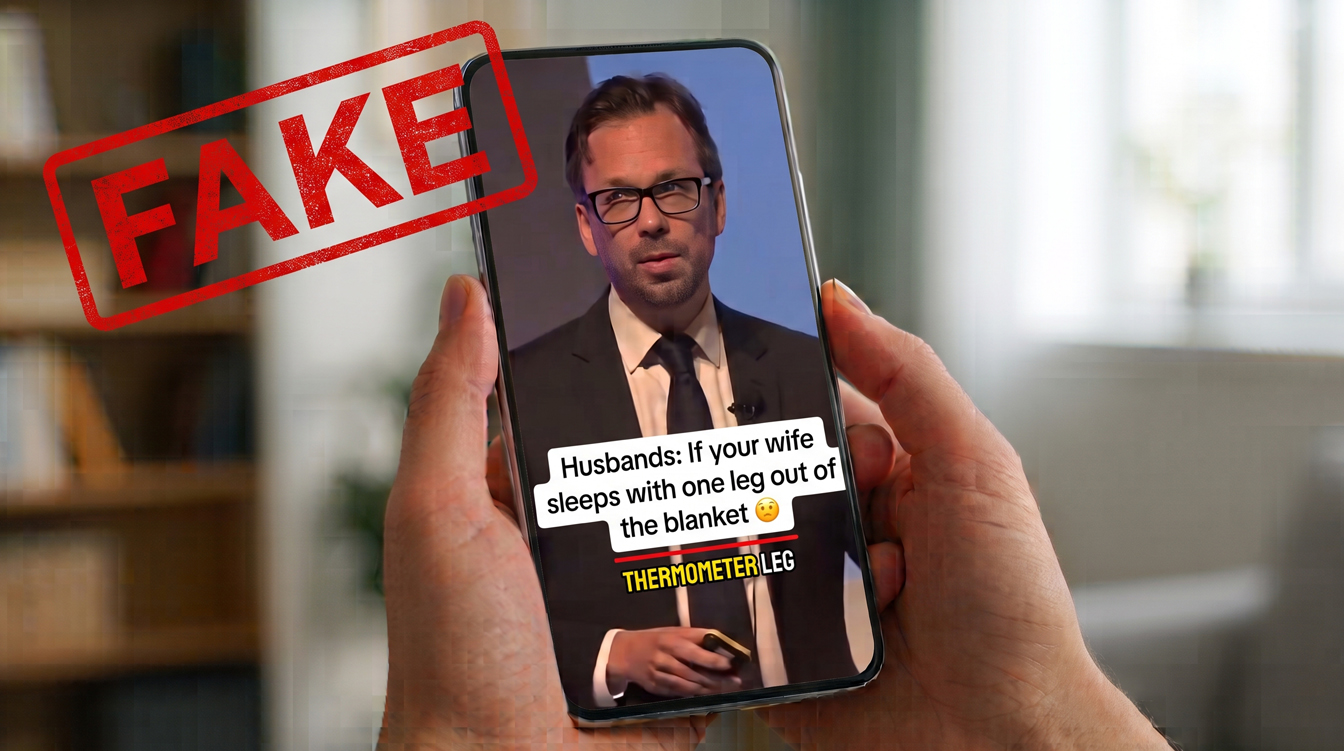
On 11 August last year, Professor David Taylor-Robinson, a real-life professor specialising in health inequalities and working out of the University of Liverpool, received an email from a colleague asking whether he knew he was on TikTok. He did not, because he was not. He is a children’s public health doctor whose work is mostly about the north-south health divide.
Excellent website Full Fact documented the story in an investigation published in December. Footage of a real appearance Taylor-Robinson had made at a Public Health England conference had been altered so that he appeared to be explaining “thermometer leg”, a supposed menopause symptom in which women who overheat at night stick one leg out from under the blanket. The fake AI professor had a great deal to say about the menopause.
Before it came down, the thermometer leg video gained more than 365,000 views, 7,691 likes and 2,878 bookmarks. “OMG that’s so me,” and “Exactly what I’m going through,” said commenters, who were being served links to buy menopause supplements. Reports to the platform were ignored. The account was only permanently banned on 24 September, after Full Fact emailed TikTok about it, roughly six weeks after Taylor-Robinson first found out. TikTok told Full Fact it had made a moderating error.
Why is this harder to disrupt than a state campaign?
Because there is no single thing to disrupt. The deepfaked professor was the front end of affiliate marketing, and the accounts pushing him linked to a US supplements company called Wellness Nest through URLs carrying referral codes. Wellness Nest told Full Fact the accounts were unaffiliated with it and that it cannot monitor affiliates around the world.
That is plausible, and it might well be true. It might also fall under the heading “plausible deniability”. Full Fact also found a blog explaining how to earn from the affiliate scheme by making deepfakes, with advice on evading platform detection, choosing who to impersonate, writing scripts in several languages and cloning voices. It is a method, published openly, that anyone can run from anywhere, and it has crossed borders: 20 Minutes found French public figures deepfaked with links to the same company in July, and LBC found Wellness Nest links on deepfakes of the late Dr Michael Mosley in August. Whether that is one network or many imitators is unknown, which is awkward for a body built to attribute.
Who is responsible for catching misinformation?
Astonishingly, nobody, as things stand. Several bodies hold part of the problem, and none is responsible for looking at the biggest question: when a health claim takes off, is it coordinated, and who is behind it?
In fact, Parliament has already kicked the can down the road at least once. The Online Safety Act was drafted with duties covering content that was legal but harmful to adults, which would have included misinformation, but they were cut in 2022 over free speech concerns. What survived is an advisory committee and an extension of Ofcom’s media literacy duties. Ofcom confirmed to the Commons Science, Innovation and Technology Committee in April 2025 that this kind of misinformation was out of scope, and the committee’s report that July asked the government to bring reporting duties back. Full Fact, who uncovered the deepfaked professor, has argued the same for years.
The MHRA acts when something is sold illegally, and it seized almost 20 million doses of illegally traded medicines last year. But a video viewed more than 365,000 times, in which a professor appears to recommend a supplement, breaks no law it enforces.Burnham’s centre, as announced, doesn’t appear to be a solution: it will ask the question only where a hostile state might be the answer.
What nobody is measuring
Nobody knows how much health misinformation in the UK is coordinated and how much is organic, or how often one seeds the other. We watch this conversation constantly, and the honest position is that the line is not drawn anywhere reliable.
It’s a problem that requires two different responses. A coordinated affiliate push is a legal problem for enforcement. Thousands of patients independently reaching the same wrong conclusion is a medical problem for the brand. Mistake one for the other and the window for either response closes. It’s one of the reasons we made sure thatBRIANNcan show which conversation an insight came from rather than returning a single sentiment score.
Burnham’s centre is the right instinct in the wrong shape for this problem, and it is the second chance in four years to give health misinformation somewhere to go. It should have people who watch health conversation for a living in the room, and not only to look for Moscow. The video that was viewed more than 365,000 times last summer was made by somebody with an affiliate link and a voice cloner, and the professor whose face they used found out from a colleague. Telling coordinated from organic decides whether the right response is legal or medical, and pharma cannot currently do it.
Patrick Charlton and Marc Burrows Published on October 2, 2026 1:24 pm
Frequently Asked QuestionsFAQs
What is the National Centre for Information Defence?
It is an organization announced to detect and disrupt hostile state information attacks and deepfakes.
How does the Online Safety Act relate to health misinformation?
The Act originally included duties to cover health misinformation but those provisions were removed in 2022.
What role do social media companies play in combating misinformation?
They are expected to collaborate with government and intelligence agencies to address misinformation issues.