

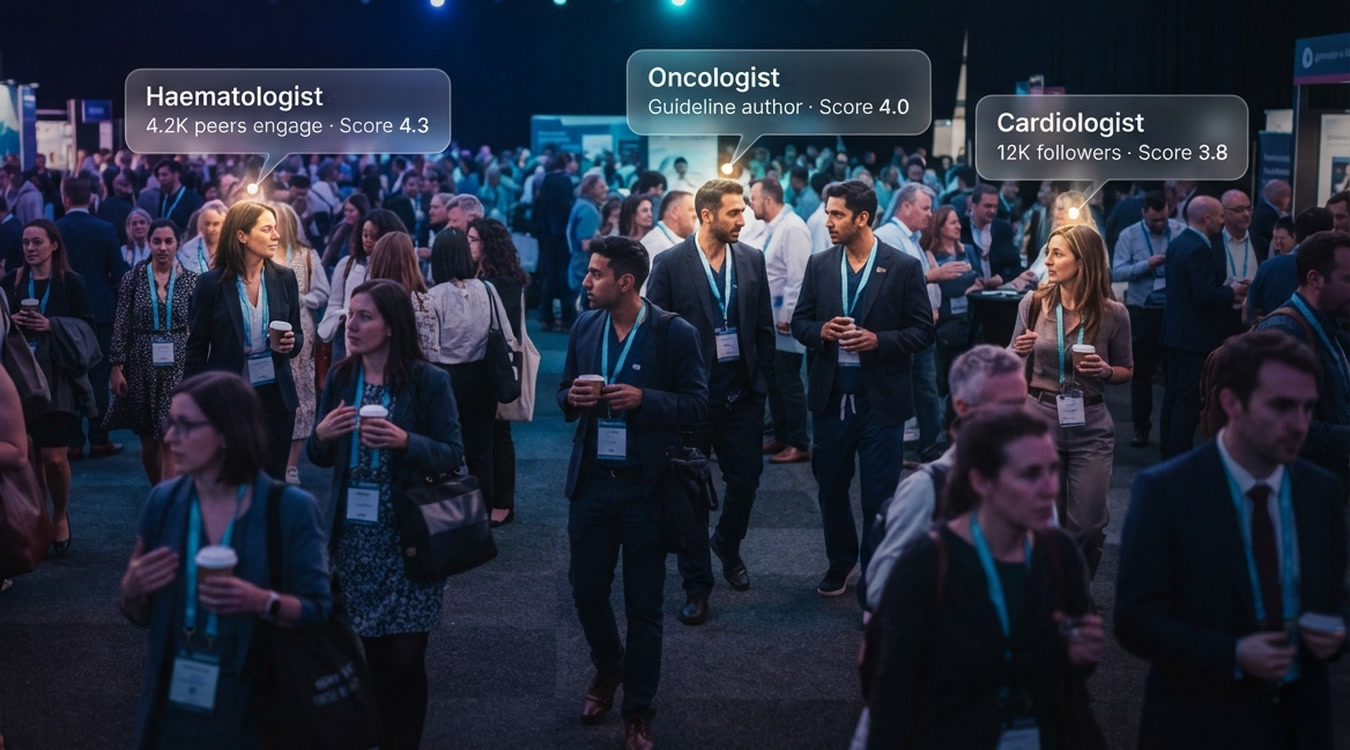
This is the method Buzz Radar uses to find and rank digital opinion leaders (DOLs) in a therapy area. We’re publishing it in full because the choices behind a DOL list, the weights in particular, should be open to argument.
What is a digital opinion leader?
A digital opinion leader is a healthcare professional whose public online activity influences how other clinicians think about a disease or treatment.
A key opinion leader’s (KOL) authority comes from their publication record, trial leadership, guideline authorship and conference platforms. A DOL’s comes from what they post in public and how other clinicians respond to it. The two overlap heavily. A professor who runs registration trials and posts about them is both. A community oncologist with no publication record whose commentary several thousand peers read each week is a DOL but not a KOL. A senior academic who never posts is a KOL but not a DOL.
For social intelligence work the difference is practical: a programme built on public conversation cannot see someone with no digital footprint, however senior they are.
Why is follower count the wrong measure?
Follower count measures how many people can see someone’s posts. It says nothing about who those people are or whether they respond.
Take two haematologists as a hypothetical example, one with 400,000 followers who are mostly patients and one with 4,000 followers who is read by the clinicians writing the treatment guidelines. For a medical affairs team trying to understand clinical opinion, the second matters more: it’s better to have a smaller, specific audience than a larger one that doesn’t contain the right people.
Three patterns cause problems, however:
- A clinician with a large general-health following built on lifestyle content has wide reach but little influence on prescribing in their specialty.
- Patient-facing accounts often have far bigger followings than peer-facing ones, and while both have uses, a patient audience tells you little about clinical opinion.
- Some influential clinicians post rarely but are quoted often, so their influence shows in who repeats them rather than in how often they post.
A better measure is whether other clinicians in the same specialty respond to, quote and argue with the person, although it takes more work to collect than a follower count.
Which criteria should you score a DOL? on here are some ideas
Score every candidate on five dimensions, each rated from 1 to 5, using weights fixed before research starts. Weights chosen after the names are known tend to favour the people someone already wanted on the list. This is a great starting point.
Dimension | Weight | What it measures |
Digital reach | 30% | Follower counts, engagement rate, posting frequency and spread across platforms |
Clinical credibility | 25% | Publications, H-index, institution, guideline authorship and certifications |
Treatment area fit | 25% | How closely their clinical focus matches the therapy area |
Client fit | 10% | Alignment with the therapy area positioning, and any conflicts of interest |
Congress activity | 10% | Speaking, chairing and society leadership at the congresses that matter in the specialty |
The weighted score is reach × 0.30 + credibility × 0.25 + treatment area fit × 0.25 + client fit × 0.10 + congress activity × 0.10. Because every dimension is rated from 1 to 5 and the weights add up to 1, the result also falls between 1 and 5.
Digital reach is the largest single dimension, but clinical credibility and treatment area fit together carry half the weight. The weights alone do not stop a well-known generalist ranking highly: a candidate who scores 5 on everything except treatment area fit, where they score 1, reaches 4.0. The tier rules below therefore set a minimum treatment area fit for the top two tiers.
BRIANN, our audience intelligence for pharma, maps DOLs in a therapy area and ranks healthcare professionals by clinical credibility and online authority.
What does a 1, a 3 and a 5 look like?
Written anchors for each score let two researchers rate the same person the same way. The follower and H-index thresholds below are starting points. Adjust them for the specialty, because follower numbers and citation rates vary between fields, and record which database each H-index came from, because citation counts differ between Scopus, Web of Science and Google Scholar.
Dimension | Score 1 | Score 3 | Score 5 |
Digital reach | No meaningful public presence, or a little-used LinkedIn profile only | Active on one or two platforms, with roughly 5,000 to 50,000 followers and regular posts | Large multi-platform following, above 100,000 on at least one platform, with frequent high-engagement posts |
Clinical credibility | Thin publication record and no notable institution or guideline role | Solid publication history, H-index roughly 15 to 30, at a recognised institution | Leading academic with an H-index of 40 or more, or a national or international guideline author, at a top-tier institution |
Treatment area fit | Works in an adjacent or general field where the therapy is a minor part of their practice | Covers the target area among several others | The target therapy is their main clinical and content focus |
Client fit | Positioning conflicts with the therapy area strategy, or heavy declared competitor ties | Neutral, which is also the default when no brand is specified | Strong alignment with the therapy area positioning |
Congress activity | No congress speaking or society role | Speaks occasionally or sits on a committee | Regularly gives keynotes or chairs at major congresses, or holds a society leadership role |
Client fit ranks people for monitoring and analysis. If the list is later used to choose people to contract, the selection criteria must relate to a documented need under ABPI Clause 24.2, so an existing relationship with the company should not be the reason someone is picked.
Where do you find digital opinion leaders?
Work through five research layers in order, each building on the last.
The first is a digital-first search. Try variations such as “[therapy area] doctors social media”, “[condition] physician influencers”, “top [specialty] on X” and “[specialty] digital opinion leaders”. Run at least ten variations and stop when three new queries in a row turn up no new names.
The second is an academic cross-reference, which catches senior clinicians who post rarely. Find the most-cited authors in the therapy area, then check each one for a digital presence. PubMed is the place to check publication records, but it does not hold citation counts, so use Scopus, Web of Science or Google Scholar for citations and H-index, or the NIH’s iCite for papers indexed in PubMed.
The third is congress and society leadership. Pull speaker lists from the main congresses in the specialty, then the boards of professional societies and the membership of guideline groups.
The fourth is searching within the platforms themselves: LinkedIn, X, Instagram, TikTok and Bluesky, where many clinicians set up accounts from late 2024. The most productive step is to look at who the DOLs you have already found follow and engage with, because peer networks surface people that keyword searches miss. Check podcast directories for physician-hosted shows as well.
The fifth is filling gaps. Review the draft list by market and specialty. If a target market has fewer than three DOLs, run targeted research for it, and if it still has none, record the gap. Do not invent names or pad the list with people from adjacent specialties.
Every name, handle, H-index and follower count should trace to a source. Where a handle cannot be confirmed as belonging to the right person, mark it as unconfirmed, since two clinicians with the same name can work in the same specialty.
How do you turn scores into a shortlist?
Rank everyone by weighted score and assign tiers by band, subject to a minimum treatment area fit for the top two tiers.
Tier | Score band | Treatment area fit | Typical use |
Top | 3.75 and above | 4 or 5 | Priority for monitoring and medical affairs attention |
Mid-top | 3.00 to 3.74 | 3 or more | Regular monitoring |
Mid | 2.50 to 2.99 | No minimum | Specific angles and niche topics |
Monitor | Below 2.50 | No minimum | Rising voices and niche specialists to track |
A candidate whose score falls in a higher band but whose treatment area fit is below the requirement goes into the highest tier they qualify for. A researcher may move a DOL by one tier, up or down, with a one-line reason recorded against the name, but the fit minimum still applies. This allows expert judgement while keeping every change visible.
Deliver the number the scoring produces. If a therapy area has four Top-tier DOLs, report four.
Which cases need special handling?
Guideline authors influence prescribing through the guideline itself, whatever their social following. Score a national or international guideline author 5 on clinical credibility.
Non-clinician patient advocates can be valuable in communities such as fertility, oncology and chronic disease. They will score low on credibility and congress activity, which is expected. Score their reach and fit normally and label them as advocates rather than HCPs, so the two groups are not mixed in one list.
Keep clinicians who consult for competitors. Their public commentary on competitor products is often among the most useful material in the dataset. Record the relationship, which lowers their client fit score, but do not remove them.
Some influential clinicians post through a hospital or department account rather than a personal one. Record the institutional account and flag it, because the rules for engaging with it differ.
Does the method work outside the US and Europe?
Only if it is adapted to the platforms each market uses. A search limited to X and LinkedIn will miss most of the relevant conversation in several major markets.
In China the main public platforms are WeChat and Weibo, and DXY (Dingxiangyuan) is widely used by Chinese doctors as a professional medical network.
In Japan the most-used social apps are LINE, YouTube and X, while LinkedIn is a small niche. X is a useful source there, but LINE is mainly private messaging and largely out of reach of public listening.
In South Korea almost everyone uses KakaoTalk, followed by YouTube and Instagram, with Naver’s Band and blogs also widely used. KakaoTalk is a messaging app, so much of the conversation on it is closed.
In much of Latin America and sub-Saharan Africa, clinicians communicate heavily through WhatsApp. In a survey of electrophysiologists across 13 Latin American countries, 88.8% said they send clinical data through instant messaging apps, and a Ugandan study found WhatsApp and Facebook were the most-used platforms among medical students.
Closed messaging groups cannot be listened to, so record them as a limit of the data rather than concluding that a market has no DOLs. Include newspaper columns and broadcast slots in the reach assessment where clinicians use them, and check what your listening tool covers in each market before drawing conclusions.
What is the difference between identifying and engaging a DOL?
Identifying a DOL is analysis of public information. Contracting one is a regulated activity.
In the UK, paid DOL work falls under ABPI Clause 24 on contracted services. Clause 24.2 requires a legitimate need that is identified and documented in advance, a written contract agreed before the work starts, selection criteria that relate to that need and payment that is reasonable and reflects fair market value. The contract must also oblige the DOL to declare the arrangement whenever they write or speak in public about its subject. Companies must disclose the fees and expenses each year under Clauses 24.4 and 24.6, in line with Clause 28.
Clause 15.6 prohibits disguised promotion. A post that reads as a DOL’s own clinical opinion, where the company shaped and paid for the message, is disguised promotion whatever the intent. Posts on open platforms also reach the public, so Clause 26.1’s ban on advertising prescription-only medicines to the public applies as well.
Monitoring HCP activity raises data protection questions. Public professional posts carry less risk than patient conversation, but a database profiling named individuals is still processing personal data. It needs a lawful basis, and the ICO says privacy information must still be provided when data comes from publicly accessible sources, unless an exemption applies. The ICO’s guidance is under review following the Data (Use and Access) Act, so check the current position. Involve compliance colleagues before building the list.
How often should a DOL list be refreshed?
Every six to twelve months. New voices appear around launches and congresses, established ones go quiet, people change institution and clinicians move between platforms. Congress calendars make a practical trigger, since new voices tend to become visible there.
How do you measure whether DOL work paid off?
Delivering the list and completing the engagements show that the work was done, not whether it had any effect. Four measures are more useful.
The first is share of voice among the DOLs you identified, tracked separately from overall share of voice, which patients, media and the public dilute. It shows whether those clinicians are discussing your therapy and in what terms. The second is message adoption: whether the framing you used appears in DOL conversation afterwards, in their own words. It is slow to show but is the strongest evidence of an effect.
The third is the questions DOLs ask in public. These change as clinicians learn, can show movement before sentiment does and tell medical affairs what to answer next. The fourth is tier movement, meaning whether Monitor-tier names you spotted early have moved up.
What goes wrong most often?
The usual problems are ranking by follower count; choosing the weights after seeing the names; dropping competitor-affiliated clinicians and with them some of the most useful commentary; treating the list as the end product rather than the starting point for monitoring and medical education planning; ignoring Monitor-tier names that may become next year’s Top tier; and running the exercise once.
Marc Burrows Published on November 16, 2026 10:17 pm
Frequently Asked QuestionsFAQs
What is a digital opinion leader in pharma?
A healthcare professional whose public online activity shapes clinical opinion among their peers. Their influence comes from digital reach and peer response rather than from publications and speaking alone.
What is the difference between a DOL and a KOL?
A KOL's influence rests on publications, trial leadership, guideline authorship and conference platforms, while a DOL's rests on public online activity. Many clinicians are both, but a KOL with no digital footprint is invisible to social intelligence.
How do you identify digital opinion leaders?
Work through five research layers: digital-first search, academic cross-reference, congress and society leadership, searching within platforms (including who existing DOLs engage with) and targeted gap filling. Score each candidate on five weighted dimensions and assign tiers by score band.
What criteria should you use to score a DOL?
Digital reach at 30%, clinical credibility at 25%, treatment area fit at 25%, client fit at 10% and congress activity at 10%, each rated from 1 to 5 against written anchors. Fix the weights before looking at any names and set a minimum treatment area fit for the top tiers.
Can pharmaceutical companies pay digital opinion leaders?
Yes, as a contracted service. In the UK that falls under ABPI Clause 24, which requires a documented need, a written contract before the work begins, fair market value payment, annual disclosure and a contractual duty for the DOL to declare the arrangement when speaking or writing publicly about it.