

Oasis fixed the queue. Social listening would have caught what came next
At a glance:Oasis sold out 42 Live ’27 shows between 25 and 27 September 2026 with a registration-only system that fixed the queues and pricing behind the 2024 backlash. Buzz Radar’s analysis is that registration measured demand but not sentiment, and the problems that remained, from failed codes and resale scams to the lingering dynamic pricing myth, are the kind social listening exists to catch.
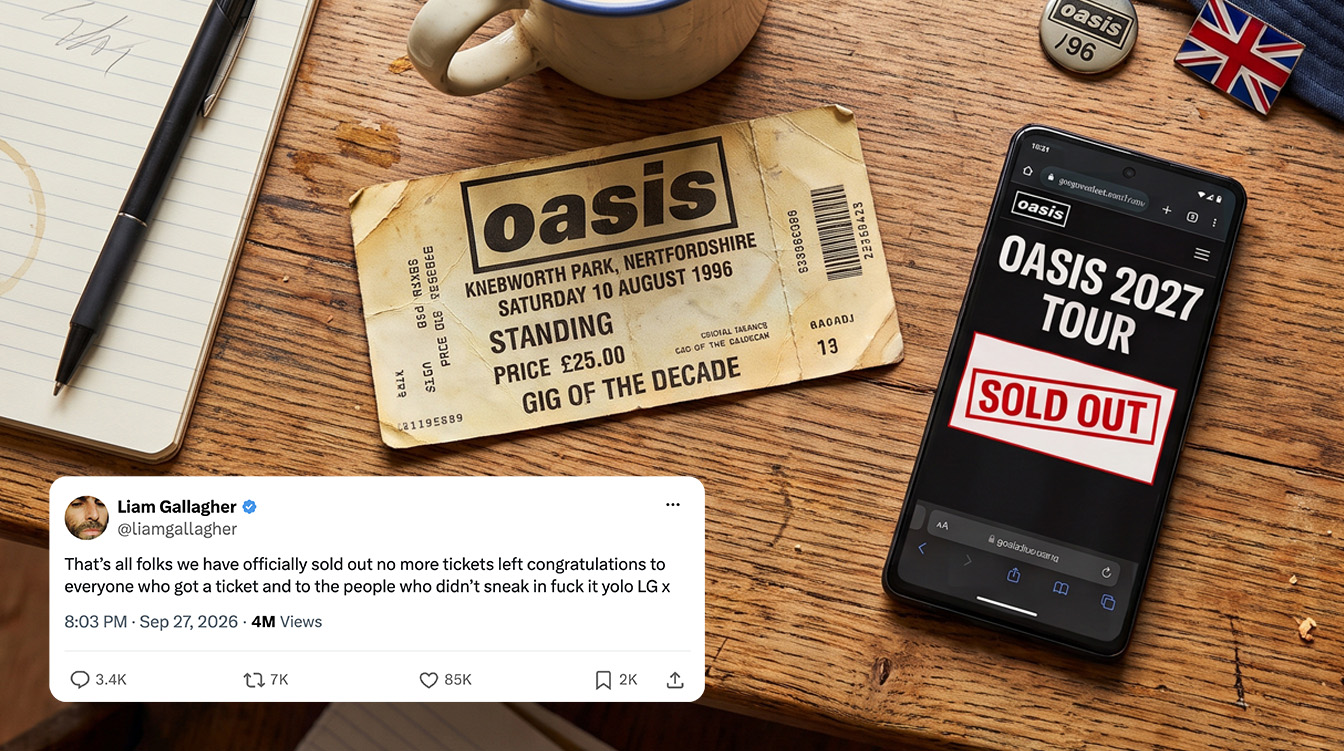
Oasis sold out all 42 dates of their Live ’27 tour over a single weekend without anybody joining a queue. Every ticket went during sale windows from Friday 25 to Sunday 27 September, for a run that includes an astonishing eleven nights at Manchester’s Etihad (capacity 60,000) and six at Knebworth (capacity 125,000), thirty-one years after the band’s legendary shows there. Liam confirmed it on X on the Sunday evening, with his customary diplomacy.
There was nothing to queue for. Fans registered in advance, were drawn at random and sent a unique non-transferable code for a specific city and sale window. UK prices were fixed and published beforehand, from £71.50 to £266.60 including fees, and barcodes are being held back rather than issued at purchase, which makes a ticket close to unsellable on viagogo or StubHub.
By most accounts it worked. NME reported fans were broadly impressed, particularly set against the chaos of two years ago. No queue, so no eight-hour wait. Fixed published prices, so no discovering at the counter that the cheap tier went an hour ago. Codes, so a harder run for bulk buyers. Whatever else this is, it is a plan built by people who, eventually, read the room.
They also added four shows, taking the tour from 38 to 42, before a single ticket had been sold. The only thing that could have told them the demand was there was the registration data. That is audience data driving a commercial decision, and it deserves credit.
But registration measures one thing, which is how many people want in. It can’t tell you how they feel about what happens next. That is the job of social listening, the practice of reading what people say in public, at scale and as it happens. It’s what we do every day. Two years ago the absence of it turned a bad Saturday into a court case, and this weekend suggests the lesson has only been half learned.
What went wrong with the Oasis ticket sale in 2024?
Cast your mind back. Oasis announced their long-rumoured and feverishly anticipated reunion on 27 August 2024. A pre-sale ballot ran on the Friday evening and general sale opened at nine the following morning, with something like ten million people chasing a bit over a million tickets. Sites buckled and queues ran to hundreds of thousands. Fans who sat in them for six or seven hours arrived at the front to find standing tickets advertised at £148.50 now listed at £355.20 under the label “in demand”, and “platinum” tickets going for nearly two and a half times standard prices in the same parts of the same stadiums, a detail the CMA (Competition and Markets Authority) would later single out. The assumption was that Ticketmaster was using “dynamic pricing”, in which prices rise automatically when demand is high.
The complaints started before lunchtime on the Saturday and never really stopped. The Advertising Standards Authority took 450 of them inside forty-eight hours. Oasis put out a statement the following Wednesday saying the band had at no time had any awareness that dynamic pricing was going to be used, and blaming an execution that failed to meet expectations. By then the CMA had opened an investigation and the culture secretary had called the prices “vastly inflated” and “depressing”. 50,000 tickets would eventually be cancelled after they turned up on resale sites.
Every bit of that happened in public. Fans were vocally outraged from the word go, and the anger had a shape and a vocabulary within hours. Millions of customers were left with a bad taste in their mouth that reflected poorly on everyone involved, from the band down.
What would social listening have caught in 2024?
Had anyone been paying the right attention to the Friday pre-sale ballot, the next few months would have been far better managed.
The pre-sale ran the evening before the main event, and the fans who had been drawn spent that evening documenting it. They posted screenshots of error codes, described being thrown out of queues after two hours, worked out between them which browsers were failing and compared how many times each of them had been kicked back to the start. By about ten o’clock that night, anybody monitoring social conversation had a detailed, timestamped account of which parts of the system were breaking and in what order.
General sale opened at nine the next morning, entirely unchanged.
None of which would have stopped the CMA, because once tickets advertised at £148.50 were selling at £355.20 the pricing was the problem. What listening changes is what came afterwards. A row that was still recoverable on the Saturday morning became an investigation, then binding undertakings, then a criminal case, largely because nobody with the authority to say anything said anything for four days.
The CMA eventually found no evidence that prices were adjusted in real time by algorithm, taking issue instead with pre-set price tiers that fans hadn’t been told about. In Dublin, Ticketmaster is contesting two charges over the Croke Park sale, back in court on 5 October.
All of which arrived at roughly the same conclusion the audience had offered for free, two years earlier, and at considerable volume. That is the commercial case for listening properly, and it is why BRIANN exists to surface what an audience is telling you while the decision is still open rather than after the lawyers have had it.
Why does everyone still think Oasis used dynamic pricing?
Because nobody corrected it in time, and this weekend’s coverage repeated it all over again. One widely syndicated report referred to Ticketmaster’s “alleged” dynamic pricing model in 2024. Another noted that the pricing model would not be used this time, as though it had been used last time. Law firms were still writing about it last year. The framing set inside about four hours on a Saturday morning in 2024, and the band’s own statement came four days later, which is fast by the standards of corporate communications and roughly three days and twenty hours too late.
Search engines and AI assistants learn what the web wrote down, not what a regulator established afterwards, and every sold-out headline this weekend added another layer. Getting the 2027 sales right doesn’t edit that back out.
What social listening sees that registration data can’t
Every problem from this weekend sits on the far side of the registration form, in the part of the process where people stop being numbers and start talking.
Being drawn was supposed to be the hard part. For some fans it wasn’t. TicketNews collected reports from people who cleared registration and then hit technical errors, failed payments, code problems and Ticketmaster’s anti-bot protections, the same system that in 2024 told fans who had queued legitimately that they were bots. Thousands with codes came away with nothing, and a claim is circulating that some buyers used one code across several windows. It may be wrong. It hasn’t been answered, and an unanswered claim on a Saturday is how the dynamic pricing story started.
Barcodes or no barcodes, tickets and purported tickets were on unauthorised resale sites almost as soon as the first window opened. This time Oasis warned fans about scams before the sale as well as after it. Last time the scale of the fraud surfaced seven months later, when Lloyds put Oasis ticket scam losses at more than £2 million. A warning helps. Knowing which scams are working and naming them the same afternoon helps more.
Then there are the millions of fans who were never drawn… which is most of the people who entered. People who lose a draw don’t crash a website. They go quiet, go to the resale market or decide the whole thing was fixed. Which of those they did this weekend, and in what proportion, is the most commercially useful thing anyone could know about this tour, and no registration form will tell you.
Demand and sentiment are different measurements, and they need different instruments. Oasis have shown they can take the first and act on it. Sentiment analysis is the one that tells you whether the fix is being received as a fix.
Reading the room, eventually
Give Oasis, or at least their ticketing team, their due. They changed a ticketing model that made them a fortune regardless, which is rare, because enough people said the same thing loudly enough for long enough. Then they used their own data to add four shows before selling a ticket, which puts them ahead of most brands.
The reason to care, if you have never queued for a gig in your life, is that the shape of this is completely ordinary. An organisation makes a decision a lot of people dislike. Those people say so at once, in public and at no cost to anybody. Somebody either reads it in time or reads about it later in a letter from a regulator. Oasis have learned to count the room. Listening to it is the next bit.
Marc Burrows Published on October 1, 2026 10:07 am
Frequently Asked QuestionsFAQs
What changes did Oasis make to their ticket sales process?
Oasis implemented a registration-only system to sell tickets, eliminating queues and dynamic pricing issues.
How did social listening play a role in Oasis's ticket sales?
Social listening could have captured audience sentiment and issues during the previous ticket sale, allowing for better management.
What problems did fans face during the 2024 Oasis ticket sale?
Fans encountered long queues, dynamic pricing, and technical errors that led to widespread frustration.