A million doctors a day now ask an AI. Can pharma see the answer?
Why is the front door of healthcare now an AI answer?
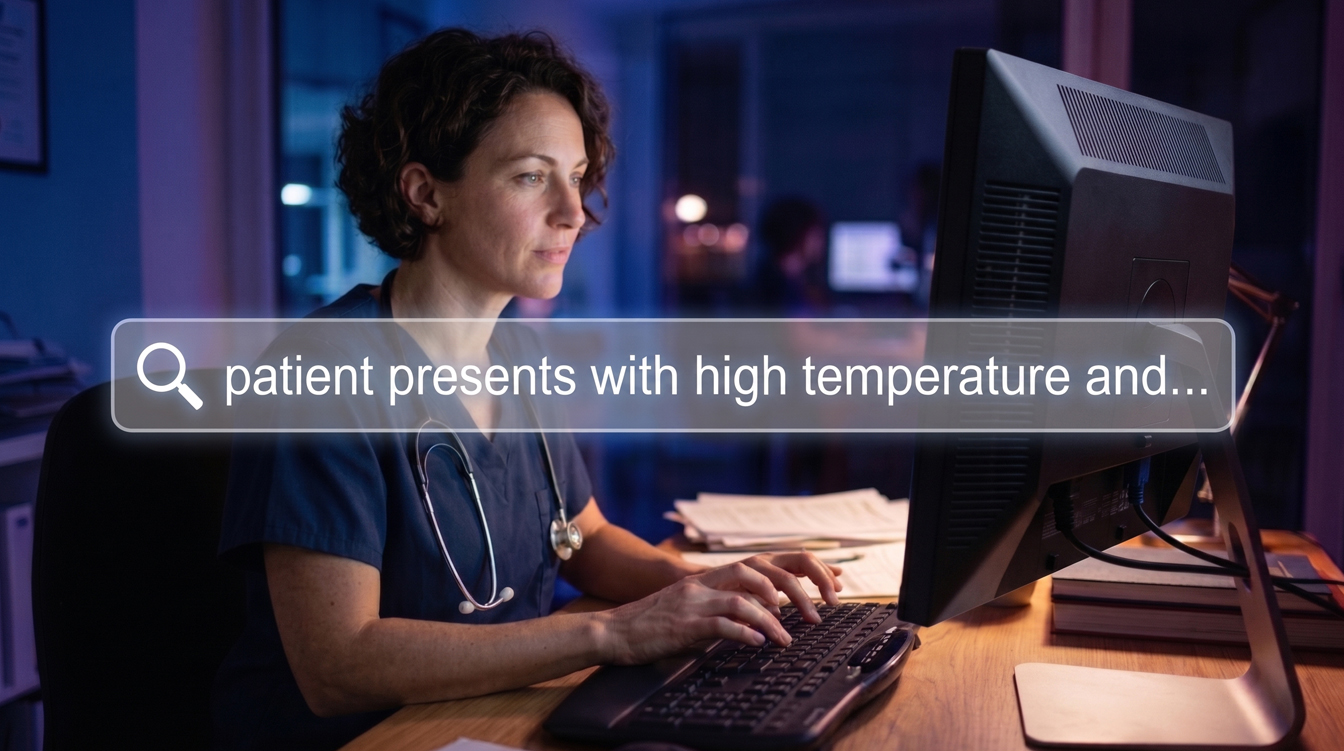
A doctor somewhere asked an AI about your therapy area this morning. The result they got is very different to what they’d have seen just a few years ago.
For two decades online healthcare search has barely changed. A doctor or patient with a question typed it into Google, scanned a page of blue links, and clicked through to a source. Pharma marketing learned to optimise for that page, and the whole omnichannel apparatus was built to be present on it.
That behaviour has shifted faster than the industry has measured it. OpenEvidence, a medical AI grounded in journals like NEJM and JAMA, is now used by more than 650,000 verified US physicians, a majority of the practising doctors in the country, and 60% of its searches are about how to make a clinical decision. It is not alone. In one 2026 survey of verified healthcare professionals, over half were already using AI-powered search such as ChatGPT in their role, with nearly seven in ten either using it or about to.
The consumer web is moving the same way. AI Overviews now appear on roughly half of Google searches, and one field study running in early 2026 found zero-click searches rose from 54% to 72% once those summaries appeared. People are reading the answer where it sits and not clicking through to find it.
What does this do to share of voice?
It retires it. Share of voice was a visibility metric built for a world where visibility led to a click. When the answer is synthesised and read in place, being seen and being chosen stop being the same thing.
Our own corpus shows the industry sensing this even as it struggles to name it. Across six years of NEXT Pharma Summit dialogue, omnichannel orchestration peaked at 13.0 mentions per 10,000 words in 2022 and has fallen to 5.6 in 2026, a decline of 57%. In its place, a topic that did not exist on stage as recently as 2023, search, SEO and answer-engine optimisation, has climbed from zero to 1.27 per 10,000 words, the fastest-compounding new cluster in the entire dataset. At the summit in Dubrovnik this May, a customer-experience keynote put it in a single line we recorded in the room: the AI funnel will replace the marketing funnel, and the winner is the one the AI recommends most.
The uncomfortable part for pharma is that this recommendation happens inside a system the brand cannot buy placement in and mostly cannot even see.
Dimension | The old front door (search and click) | The new front door (AI answer) |
What the user sees | A page of ranked links | One synthesised answer |
Winning metric | Share of voice, ranking, clicks | Whether you are recommended in the answer |
Click behaviour | Click-through to the source | |
Where the brand can act | Content, SEO, paid placement | Influence the source conversation, then monitor the output |
Visibility to the brand | Rank trackers, analytics | Largely invisible without active monitoring |
Why is this a measurement problem before it is a content problem?
Because you cannot optimise for what you cannot see. The instinct will be to rush at AEO the way the industry rushed at omnichannel, as a content production exercise, restructuring pages into FAQs and schema and hoping the machine notices. Some of that helps. None of it tells you what the machine is actually saying to a cardiologist about your drug versus the competitor’s this week.
On our reading of the transcripts, 2026 is the year pharma started demanding proof rather than capability, with proof-and-accountability language hitting its own six-year peak. Answer-engine visibility is that same demand arriving somewhere new. Content was king for a long time, on the belief that good content earned ranking, visibility and share of voice. We're leaving those days behind fast. The most important question isn’t “is our content good enough”, it’s what comes back when a doctor asks an AI about a therapy area, whether it is accurate, and how it compares to what comes back about everyone else. That is a monitoring discipline, and it sits much closer to social and audience intelligence than to SEO.
It is also where trust gets tested. At Cannes Lion this year, pharma was expected to arrive ready to show its working on AI rather than its ambition. An answer engine that misstates a contraindication, or simply leaves your treatment out of the considered set, is both a commercial loss and a medical risk. You want to know before the regulator or the clinician does.
Where does this leave a pharma brand right now?
It leaves you needing to watch the machine, where before you only fed it. This is the newest job we built BRIANN, our audience intelligence for pharma’s toughest jobs, to take on. It sees what AI answer engines tell HCPs and patients about a treatment, and how that compares to the competition, and shows it as it shifts rather than letting a brand find out by accident. It reads the same conversation the answer engines draw on, the posts, videos and podcasts around a therapy area, and shows what is being synthesised back out. Every output is sourced and its method is explained, with a dedicated human expert overseeing output and available for clarifications and adjustments, because an AI left to grade other AIs unsupervised would be repeating the trust problem this is meant to solve.
The strategic point stands whether or not a brand ever uses our tool. The front door has moved, and the metric for winning has moved with it. Pharma spent the last decade learning to show up in every channel. The next decade is about knowing what the machine says when no one is in the room to hear it.
A doctor somewhere asked an AI about your therapy area this morning. The answer already exists. The only thing still in your hands is whether you have read it.
Patrick Charlton Published on August 31, 2026 1:02 pm
Frequently Asked QuestionsFAQs
What is answer engine optimisation (AEO) for pharma?
AEO is the practice of making sure AI answer engines such as ChatGPT, Google AI Overviews, Perplexity and clinical tools like OpenEvidence surface accurate, compliant information about a brand or therapy area. For pharma it is as much a monitoring and medical-accuracy responsibility as a marketing one, because HCPs and patients increasingly <a href="https://varnhealth.com/industry-insights/hcp-ai-search-usage/">act on the AI answer directly</a> rather than clicking through to a source.
How is AI search different from traditional SEO for pharma brands?
Traditional SEO optimised for ranking on a results page that a human then clicked. AI search synthesises an answer that is read in place, so the majority of searches now <a href="https://www.searchenginejournal.com/ai-overviews-cut-organic-clicks-38-field-study-finds/573145/">end without a click</a>. Success shifts from being visible and clicked to being accurately represented and recommended inside the answer, which you can only manage if you can see what the engines are saying.
Can a pharma company actually track what AI tells doctors about its products?
Yes. You monitor the conversation and content these engines draw on, and the answers they return for a therapy area, then compare your brand against competitors over time. This is the job BRIANN's AI-discovery agent does, with sourced outputs and a human pharma specialist accountable for them, so the findings hold up in commercial, medical and compliance settings.