The Sora Shutdown is a wake-up call for every brand chasing the AI hype cycle
In December, OpenAI and Disney announced a deal, a billion-dollar investment that felt like a genuine glimpse of what AI content could become. It would involve three years of character licensing with over 200 Disney, Marvel, Pixar and Star Wars properties lined up for AI-generated video, allowing the company’s Sora video generating app to become a real playground of pop culture content. The press were calling it the AI TikTok.
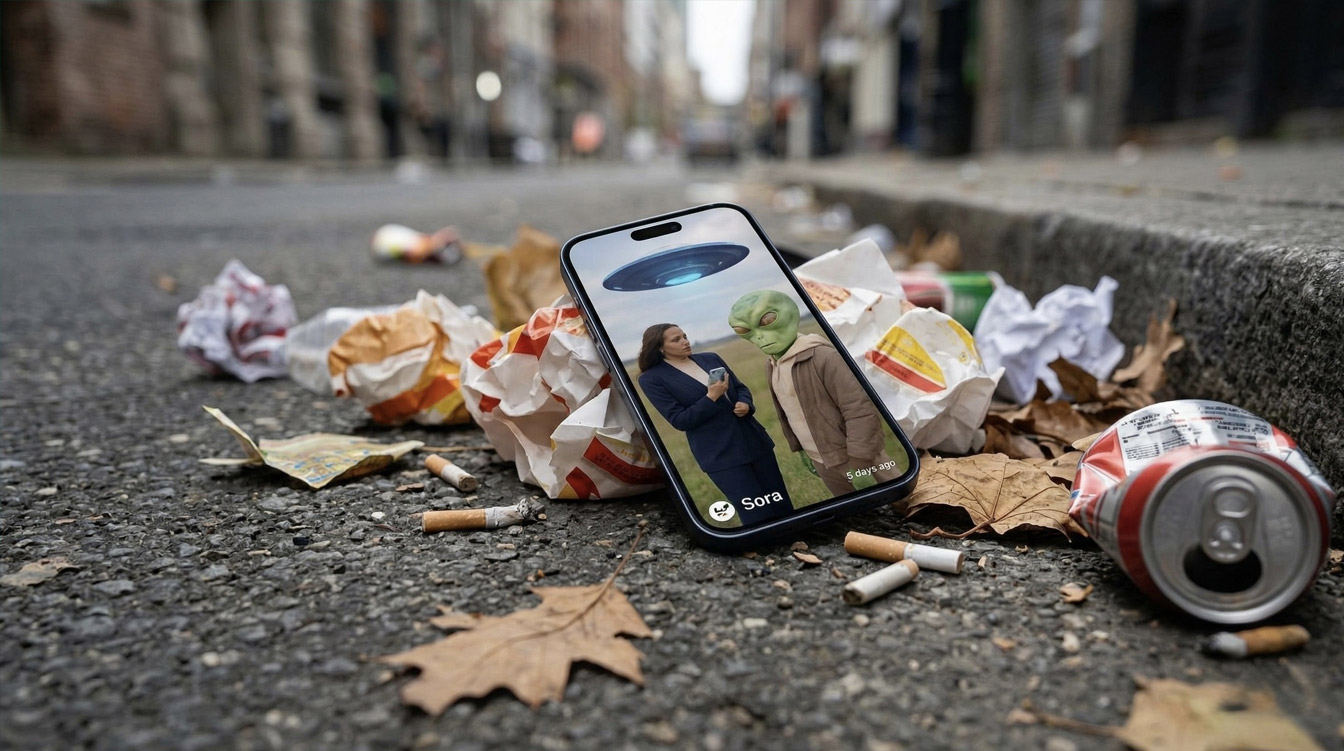
Three months later the deal, along with Sora itself, has vanished in a puff of smoke.
On Tuesday, OpenAI pulled the plug on Sora with little more than a thank-you post on X, with the Disney dealOver before a single dollar changed hands.
A billion-dollar partnership between one of the world’s biggest entertainment brands and the world’s most recognisable AI brand didn’t survive a single quarter. That’s something smart brands need to pay attention to.
The numbers tell the story
Sora launched in September 2025 and the hype was immediate. It hit a million downloads faster than ChatGPT. By November, it peaked at 3.3 million monthly downloads. By February, downloads had dropped to 1.1 million. Lifetime in-app revenue was at£1.7 million. Against OpenAI’s compute costs, which are absolutely titanic, that’s essentially pennies.
It meant that the app was eating through processing power with no realistic path to paying for itself. With an IPO on the horizon, OpenAI chose to redirect those resources toward enterprise tools and coding products. The stuff that actually makes money.
So why should marketers care?
If you’d built a content strategy around Sora in October, and plenty of agencies were doing just that, you’d now be reworking a core part of your 2026 plan. Some brands were genuinely looking at Sora as a productions tool, which is understandable. It could create one of the holy grails of social content: eye-catching, cheap and easy-to-produce video. Others were building creator partnerships around AI video on the platform.
All of that’s been pulled from under them.
It’s an example of what happens when brands build strategies around hype-driven consumer products before anyone’s proved the use case, and it’s something that’s echoed down the history of online business from the dotcom boom, through the rise and fall of Web 2.0 darlings, to NFTs and the metaverse. All cycles where the promise arrives fully formed, and the purpose has to scramble to catch up. Clubhouse had the same trajectory – viral launch, massive growth followed by rapid decay.
These platforms move at a pace where a flagship product can go from landmark deal to shutdown in 90 days. The damage becomes far worse when brands are building strategies, hiring teams and committing budgets around them.
The problem isn’t AI. It’s hype without substance.
None of this means AI is the problem. We know from developing BRIANN that AI can lead to tangible, and remarkable, productivity gains, especially when the tech is designed to solve real, specific problems in specific industries.
The problem is when brands jump on a platform without asking the basic questions. Is there a sustainable business model? Is adoption real or just novelty? Does it actually solve a problem my audience has?
Sora was impressive technology looking for a purpose. Beyond novelty, it never found one that stuck.
What the smart brands are doing differently
The brands getting this right aren’t steering clear of AI. They’re just not putting all their chips on hype alone.
They’re paying attention to the signals. Where is real adoption actually happening, versus where is the excitement running ahead of the fundamentals? They’re watching for sentiment shifts before those shifts become headline news. And they’re keeping their strategies loose enough to move when the ground shifts. Because it will.
That’s what social listening is for. Not just counting mentions, but reading the room. Working out whether a platform’s momentum is real and lasting, or whether it’s just another Clubhouse waiting to happen.
The takeaway
For better for for worse (and in terms of deepfakes and misinformation that there are a lot of people who would argue that it’s for worse) this isn’t a story about AI video failing. The tech is good and it’s not going away. Google, ByteDance and others are all still pushing hard on this.
Instead, this a story about what happens when you confuse a product launch with a stable platform, and let hype drive your strategy instead of data.
Don’t build your strategy around someone else’s experiment. Use the data to spot what’s real, what’s fading and what’s coming next. Before you commit.
The next Sora is already being hyped somewhere. It’s worth knowing whether you’re looking at a breakthrough or a bubble before your budget’s on the line.
Marc Burrows Published on March 26, 2026 10:42 am
Frequently Asked QuestionsFAQs
Why did OpenAI shut down Sora?
OpenAI shut down Sora on 24 March 2026 because the app’s compute costs vastly outweighed its revenue. Lifetime in-app revenue was approximately $2.1 million while inference costs were estimated at $15 million per day at peak. With an IPO approaching, OpenAI redirected resources toward enterprise products and robotics research.
What happened to the OpenAI Disney deal?
Disney’s $1 billion investment in OpenAI and three-year character licensing deal for Sora was cancelled when OpenAI shut the platform down. No money ever changed hands. Disney reportedly learned of the decision just one day before the public announcement.
How fast did Sora’s downloads decline?
Sora peaked at approximately 3.3 million monthly downloads in November 2025. By February 2026, downloads had fallen to around 1.1 million, a decline of roughly 67% in three months. The app generated only $2.1 million in total lifetime revenue.
How can brands avoid getting caught by AI hype?
Use social listening and platform data to separate genuine adoption from novelty before committing budget. Ask three questions: does the platform have a sustainable business model? Is user growth real or hype-driven? Does it solve a problem your audience actually has? Monitor sentiment shifts rather than download headlines.
Is AI video dead after Sora?
No. AI video generation technology is not going away. Google, ByteDance and others continue to invest heavily. What died was a specific consumer product with unsustainable economics, not the underlying technology. The distinction matters for any brand evaluating AI video tools.